
By Jesús R. González, Owner & Personal Injury Attorney, Jesús R. González, P.A.
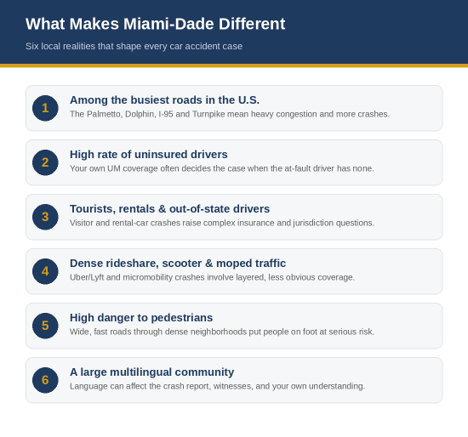
Quick answer: Miami-Dade car accident cases follow the same Florida laws as the rest of the state, but several local realities make them harder and higher-stakes: some of the heaviest, most congested traffic in the country; one of the highest rates of uninsured and underinsured drivers in Florida; a constant flow of tourists, rental cars, and out-of-state drivers; dense rideshare, scooter, and moped traffic; serious danger to pedestrians; and a large multilingual community that adds complexity to every claim. Here is how those differences actually affect your case.
Same Florida law, very different reality
The legal framework is statewide. Florida is a no-fault state, so your own PIP coverage pays first regardless of who caused the crash, and recent changes to Florida law shortened the time you have to file and changed how shared fault is handled. Those rules apply in Pensacola and in Miami alike.
What is different in Miami-Dade is the environment those rules operate in — denser traffic, more uninsured drivers, more outside parties, and more complex claims. The law is the same; the battlefield is not.
Some of the busiest, most dangerous roads in the country
Miami-Dade is Florida’s most populous county, and its highways — the Palmetto (826), the Dolphin (836), I-95, and the Turnpike — carry some of the heaviest, most aggressive traffic anywhere in the U.S. High volume and congestion mean more crashes, more multi-vehicle pileups, and more disputes about exactly how a wreck happened. That puts a premium on evidence: crash reports, camera footage, and witness statements gathered quickly.
A high rate of uninsured and underinsured drivers
Florida consistently ranks among the worst states for uninsured drivers, and Miami-Dade is one of the hardest-hit areas. That matters enormously, because if the driver who hit you has no insurance or minimal coverage, your recovery may depend on your own uninsured/underinsured motorist (UM) coverage. In Miami, checking for and maximizing UM coverage is not a footnote — it is often the whole case.
Constant tourists, rental cars, and out-of-state drivers
Few places in the country see the visitor traffic Miami does — the airport, the cruise port, South Beach, and year-round tourism. That means a large share of crashes involve rental cars, out-of-state drivers, and even foreign visitors. These cases get complicated fast: which state’s insurance applies, how to reach a driver who has flown home, and how rental-company and tourist policies work. Local experience handling these wrinkles makes a real difference.
Dense rideshare, scooter, and moped traffic
Miami’s urban core runs on Uber, Lyft, food-delivery drivers, and a growing wave of scooters and mopeds. Rideshare crashes raise hard questions about which insurance applies and when, and scooter and moped riders are especially vulnerable in heavy traffic. These are not ordinary fender-benders — they involve layered coverage and parties most drivers do not think about.
One of the most dangerous areas for pedestrians
Florida is repeatedly ranked among the most dangerous states for pedestrians, and the Miami metro area is a big reason why. Wide, fast roads cutting through dense neighborhoods put people on foot at serious risk. Pedestrian cases here carry their own rules around PIP, fault, and severe injuries.
A large, multilingual community
Miami-Dade is one of the most diverse counties in the nation, and a huge share of residents are most comfortable in Spanish. That affects everything from how the crash report reads to whether witnesses can be understood to whether you fully understand your own case. A firm that works fluently in your language — and knows this community — protects you from things getting lost in translation at the worst possible moment.
What this means for your claim
The takeaway is simple: a Miami-Dade crash is not just “a Florida car accident.” The local mix of traffic, uninsured drivers, outside parties, and language makes these cases more complex than average — and that complexity is exactly where an experienced local firm earns its value. Knowing how Miami-Dade’s roads, insurers, and courts actually work is a practical advantage in getting you a fair result.
What to do next
If you were hurt in a crash anywhere in Miami-Dade, do not try to sort out uninsured coverage, rental-car insurers, or a rideshare claim on your own — and do not let the insurance company decide what your case is worth. Call Jesús R. González, P.A. today for a free, no-obligation consultation in English or Spanish. We know these roads, these insurers, and this community. If we take your case, you pay nothing unless we win.
Hurt in a crash in Miami-Dade? Talk to a local firm that knows these cases.
Free consultation — English & Spanish — you pay nothing unless we win.*
Call Jesús R. González, P.A. now: (305) 889-8717
Frequently asked questions
Yes. Florida requires PIP coverage, which pays your initial medical bills and lost wages regardless of fault. You may step outside no-fault and pursue the at-fault driver when injuries are serious enough to meet Florida’s threshold.
Your recovery may depend on your own uninsured/underinsured motorist coverage. Because uninsured drivers are common in Miami-Dade, checking for and maximizing UM coverage is often critical to these cases.
It depends on the rental company’s coverage, the driver’s own policy, and sometimes their home-state insurance. These cases are more complex than a typical crash, which is why local experience matters.
Florida law sets strict deadlines, and recent changes shortened the window for negligence claims. Because missing the deadline can end your case, it is important to confirm the current limit early.
The law is the same statewide, but the local mix of heavy traffic, uninsured drivers, tourists, rideshare, and a multilingual population makes Miami-Dade cases more complex in practice.
*You may still be responsible for case costs even if no attorney’s fee is charged. The hiring of a lawyer is an important decision that should not be based solely upon advertisements. This article is general information, not legal advice. IMPORTANT: verify all statements of Florida law (no-fault/PIP, filing deadlines, comparative fault) against current statutes, and confirm all wording against current Florida Bar advertising rules, before publishing.